The observer
A lonely child who photographs what he cannot keep, and an older man discovering that memory preserved the emotional truth while getting some of the facts wrong.
A boy remembers a girl he failed to photograph. More than fifty years later, an undelivered letter changes what he thought that summer meant.
Present-day Harry is writing a memoir. The act of writing pulls him back to 1969, when he was ten: an isolated boy in Romford, a Welsh father emotionally elsewhere, a German mother whose language is almost forbidden in a town still carrying the memory of wartime bombing, and a camera he has quietly appropriated as a way of making private order out of the world.
Summer takes him to Ceredigion, to his deaf and formidable grandmother and a village where Welsh is spoken over his head. Harry understands almost nothing of what is said around him. The audience sometimes understands more. That gap — between what a child believes and what was actually happening — becomes the film's central method.
Then he meets Vanessa, twelve, visiting with her family. She talks easily where Harry does not. She takes his hand, leads him through a milking parlour, listens seriously when he explains his camera and makes an afternoon feel briefly as though somebody has noticed him.
Harry photographs the empty milking stalls, the churn stand and the yard. Vanessa stands in the gateway in long evening light, and for a moment he means to photograph her. He cannot find a way to ask without making the moment feel different, so he puts the lens cap back on. It becomes the only frame he ever regrets not taking.
Vanessa leaves unexpectedly. She writes and gives Harry her address. He replies — eventually — but gets his own address wrong. Nothing comes back. Two years later he makes the journey to St Albans and reaches the house too late: Vanessa's father has died and the family has gone. A letter left for Harry in the doorframe remains there after he walks away, softening in the rain.
For most of his life Harry interprets the silence as rejection, bad timing or simply something that belonged to childhood.
Decades later Harry finds Vanessa's family. A box arrives. Inside is a letter she sent in October 1969, returned by the Post Office because Harry had written his own house number wrongly. She had answered him within weeks. She kept the returned envelope for half a century.
There is another envelope too, written by Vanessa when she was older and had nowhere to send it: simply, For Harry. The film does not read it aloud. Instead it returns to Ceredigion, to the gate and the long amber light, to the photograph Harry never took and the image he never stopped carrying.
The story therefore does not repair the loss. It changes its meaning.
The present-day role of Harry carries the film's retrospective weight; the period story depends on the restraint and specificity of the two children.
A lonely child who photographs what he cannot keep, and an older man discovering that memory preserved the emotional truth while getting some of the facts wrong.
Curious, direct and socially effortless where Harry is hesitant. She gives him the unusual experience of being listened to as though what he says matters.
Harry's Welsh and German inheritance, his father's distance, his grandmother's apparent severity and the adults around Vanessa all carry meanings the children can only partly see.
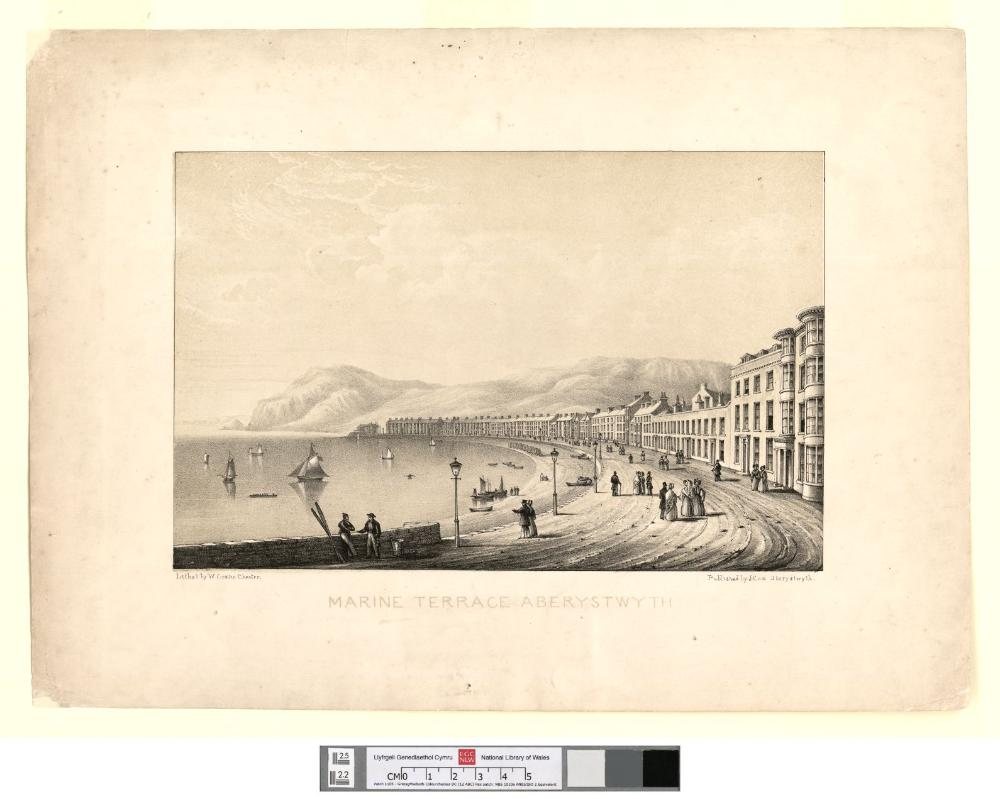
Historic Aberystwyth image released CC0 via the National Library of Wales/Wikimedia Commons. Image credits.
← Current Projects